13 running · 4 open source

13 AI agents running real businesses. Four are on GitHub.

They hunt for watches worth buying, price them, write and publish, and handle the repetitive end of businesses that used to eat every evening. The four pieces worth copying are free on GitHub, with the lessons from what broke first. Architecture and lessons only, no private, live or financial data is published here.

A room full of Walters at laptops, with a small robot helping
13AI agents in production
4open-source repositories, MIT
3businesses automated
0of them can spend money
In short

What do AI agents do for an e-commerce consultant?

In my case, they take the repetitive end of running small online businesses: they watch marketplaces, price stock against the market, write and publish content on a schedule, fix a website's SEO every week and report back over WhatsApp. None of them can spend money or place a bid. I decide what each AI agent does and check what it produces.

The repositories

Four things worth copying.

01

Know when a scheduled AI agent silently dies

A dead-man switch and control tower for scheduled Claude Code AI agents. Every run pings when it starts and when it finishes. A start with no finish raises an alert and a desktop notification within five minutes.

  • Three independent signals: dead-man pings for hung runs, missed cron slots for runs that never started, and transcript scoring for runs that finished but delivered nothing.
  • A free gate scans the fleet first. The model only wakes up for events that score high enough, so a quiet fleet costs no tokens.
  • Plain Python, standard library only, 16 passing tests.
What broke

The worst failure was a confident "nothing to report" that actually meant "I could not see anything". Both read identically from the outside, so a missing final report now counts as a failure.

git clone https://github.com/waltermitas/ai-agent-fleet-monitor.git

Then copy the four scripts and add one ping line to each scheduled task. The README has the five steps.
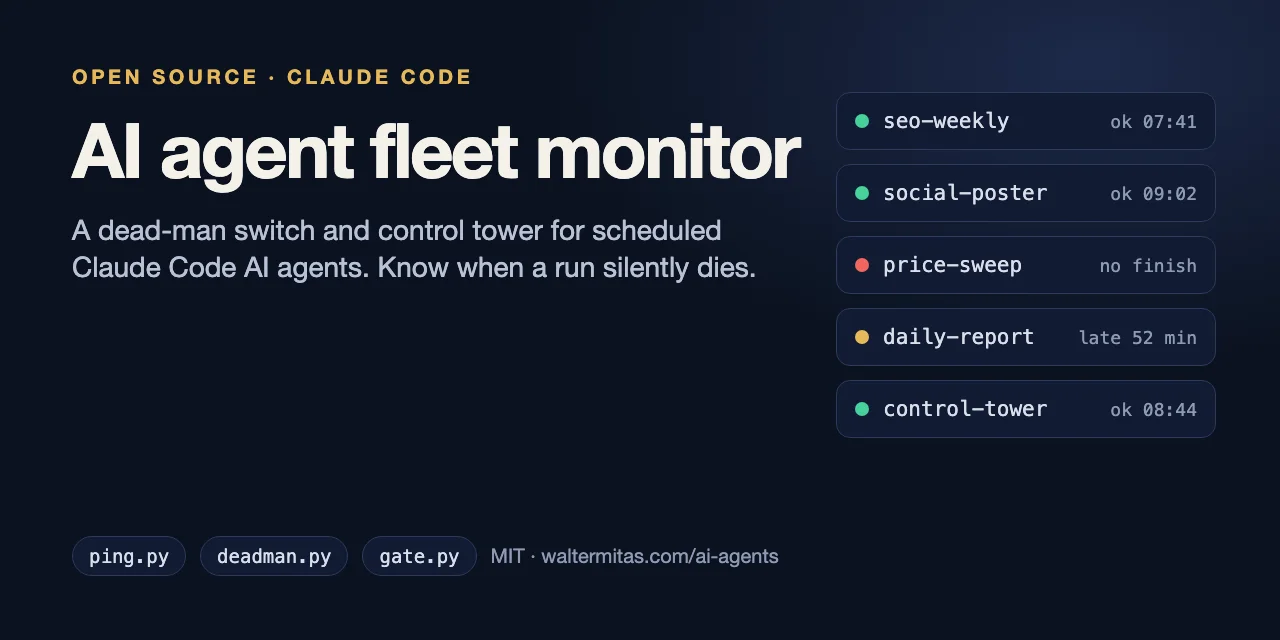
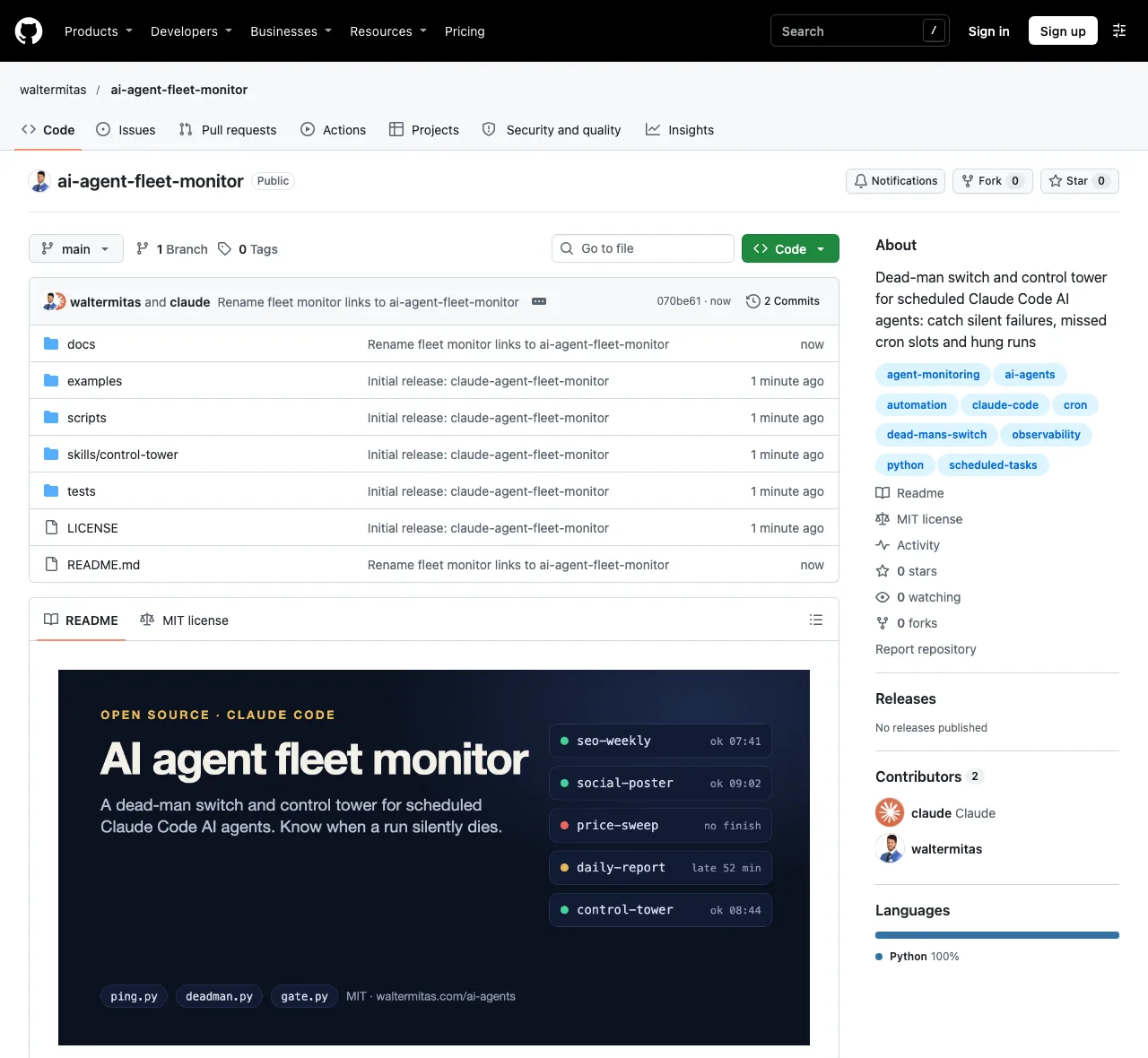
The ai-agent-fleet-monitor repository page on GitHub, showing the README banner and badges
The repository as published on GitHub.
02

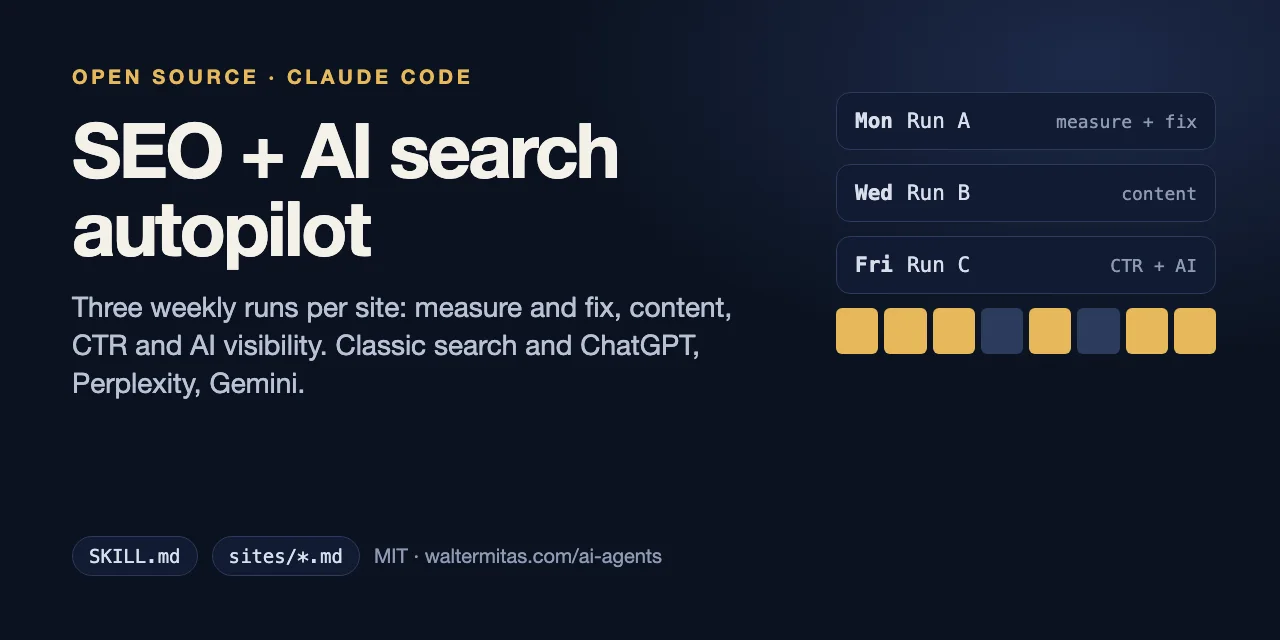
SEO and AI search on autopilot, three runs a week

A Claude Code skill that crawls a site, runs Lighthouse, reads Google Search Console, fixes what is safe, pushes and measures the result 28 days later. It covers classic search and AI search in ChatGPT, Claude, Perplexity, Gemini and Google AI Overviews.

  • Three runs a week, one focus each: measure and fix, content, then click-through rate and AI visibility.
  • A Search Console regex for long questions, with the unattended URL form that actually applies it, turns real queries into answer blocks on pages that already rank.
  • Guardrails per site: a build gate, a NEVER list, weekly caps and one commit per run, so a bad week is a one-line revert.
What broke

An AI agent that can commit needs a blast radius, not a review queue. The fix was limiting what it may reach, and a pre-flight check that refuses to push over files a human edited by hand.

git clone https://github.com/waltermitas/claude-seo-autopilot.git
cp -r claude-seo-autopilot/skills/seo ~/.claude/skills/seo

Copy the example site file, fill in your repository and Search Console property, then schedule one task per site.

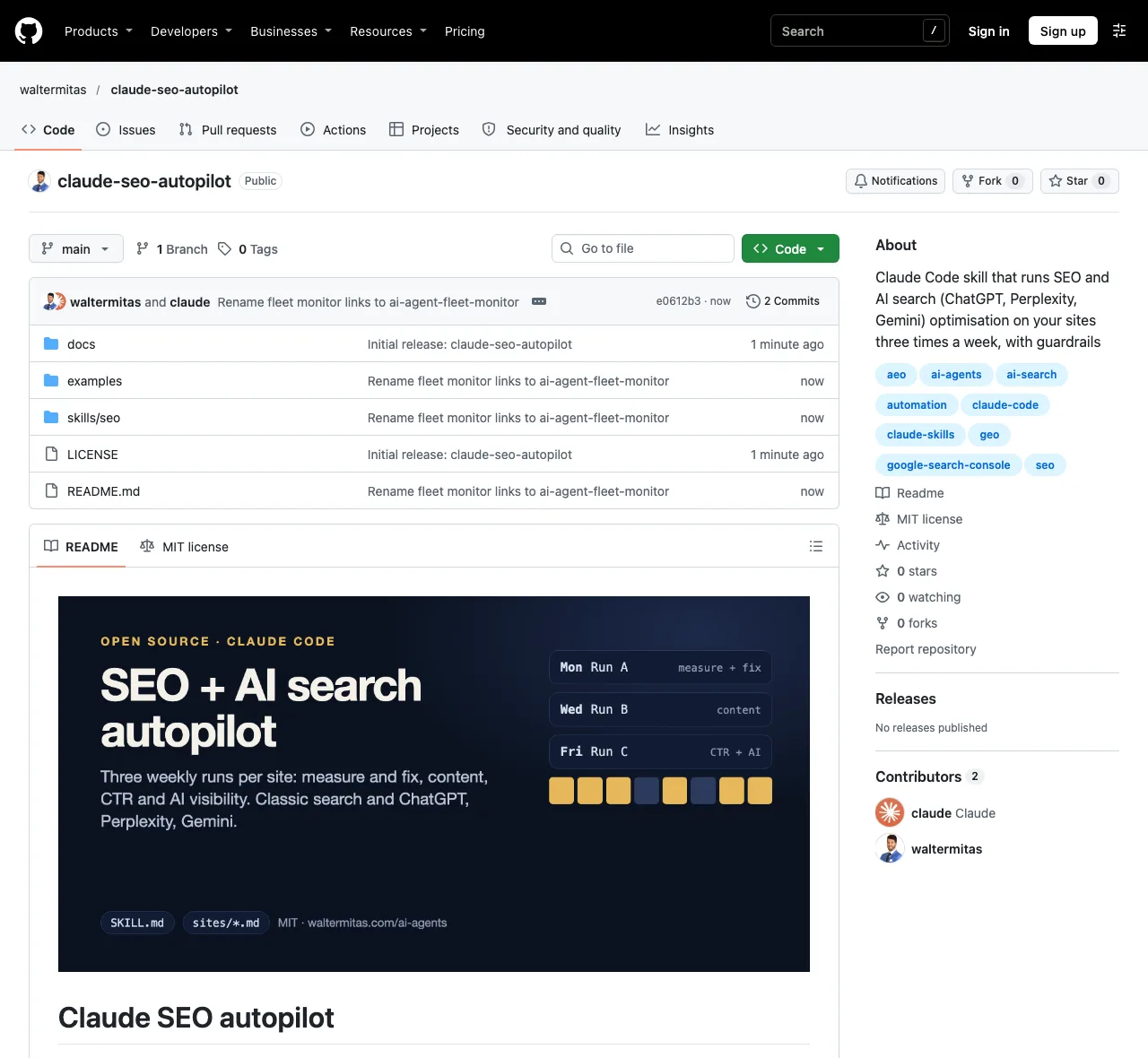
The claude-seo-autopilot repository page on GitHub, showing the README banner and badges
The repository as published on GitHub.
03

AI agents that hunt underpriced watches while you sleep

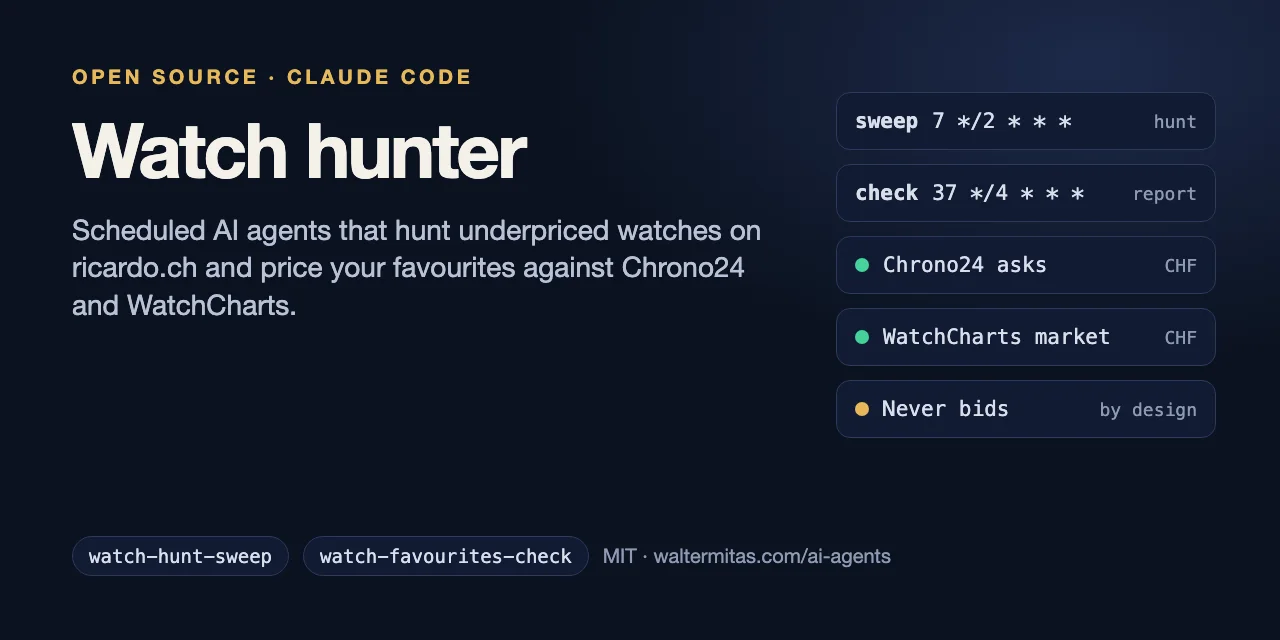
Two scheduled skills for ricardo.ch, Switzerland’s biggest auction site. Every two hours a sweep opens the promising listings, reads the photos, identifies the reference and favourites lots trading under market. Every four hours a second skill reports your favourites against Chrono24 and WatchCharts.

  • Reference identification from the caseback, the dial and a reverse image search, with every match treated as a candidate, never a confirmation.
  • "The market" is the lowest of three numbers: Chrono24 asks, WatchCharts market price and eBay asks. Labelled as asks or estimates, never blended.
  • It never bids, never contacts a seller and never bypasses a CAPTCHA. A person decides.
What broke

Fetching a lot page is challenged almost every time, while navigating to it works. Pace matters more than volume: the rate limiter reacts to speed, not to the total number of requests.

git clone https://github.com/waltermitas/watch-hunter-skill.git

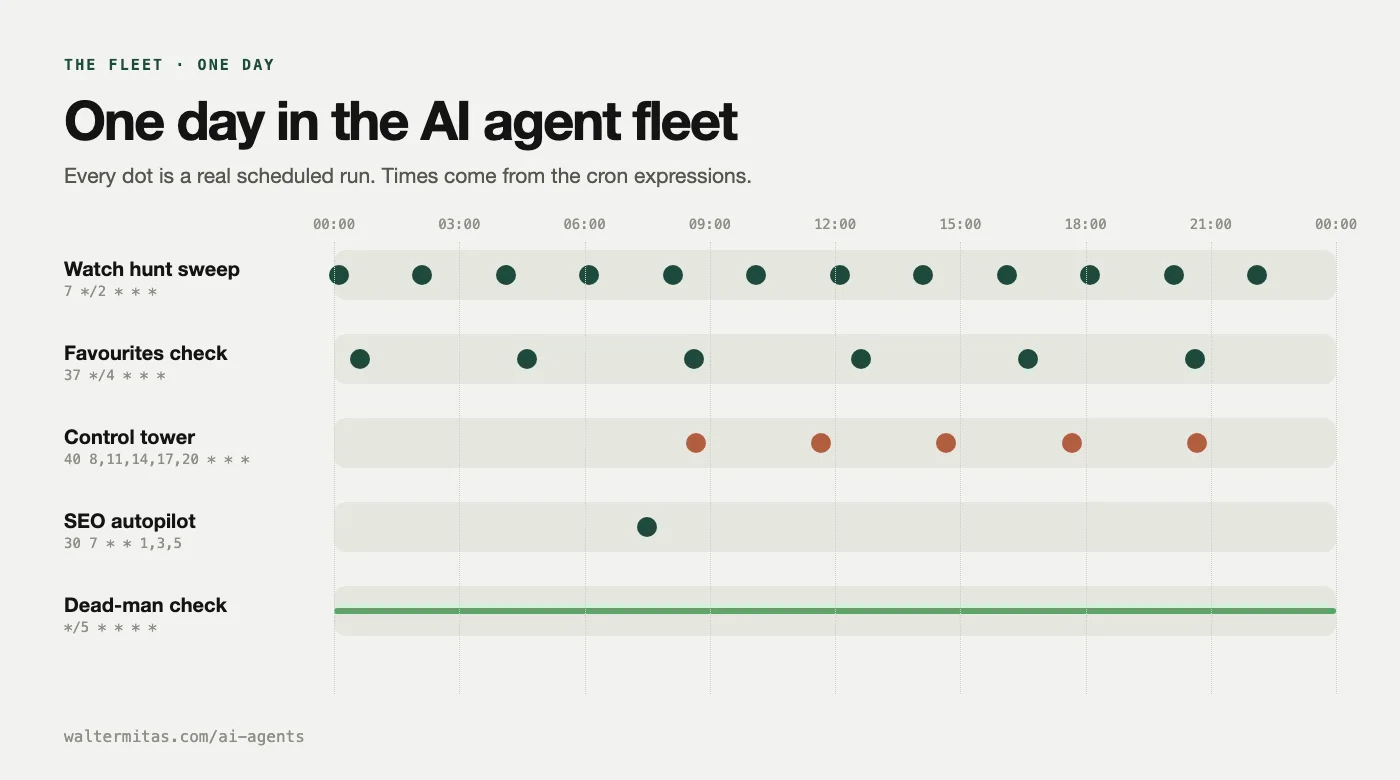
Create each skill as a scheduled task with its cron expression: 7 */2 * * * for the sweep and 37 */4 * * * for the favourites check.

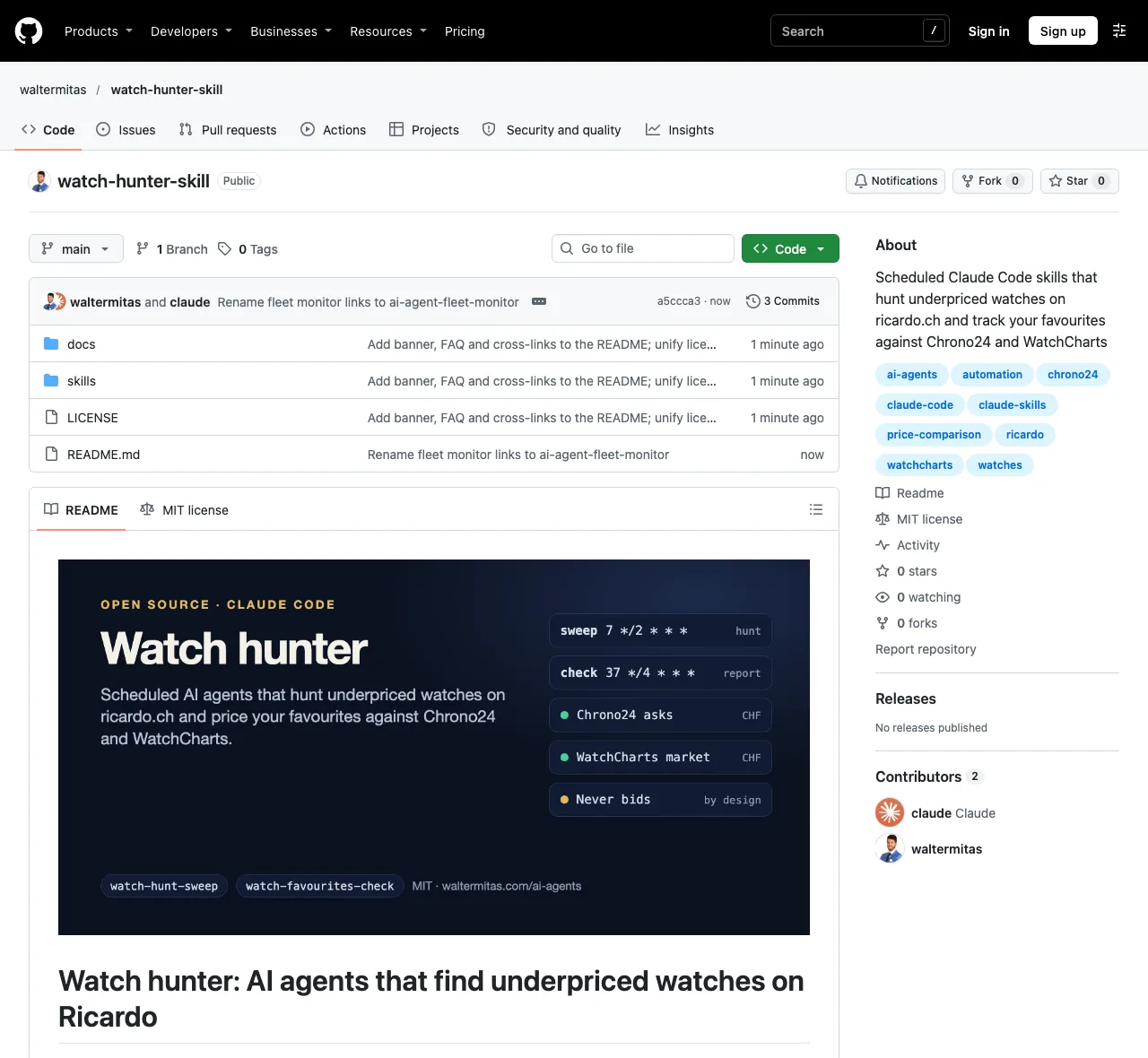
The watch-hunter-skill repository page on GitHub, showing the README banner and badges
The repository as published on GitHub.
04

One watch reference in, a full YouTube package out

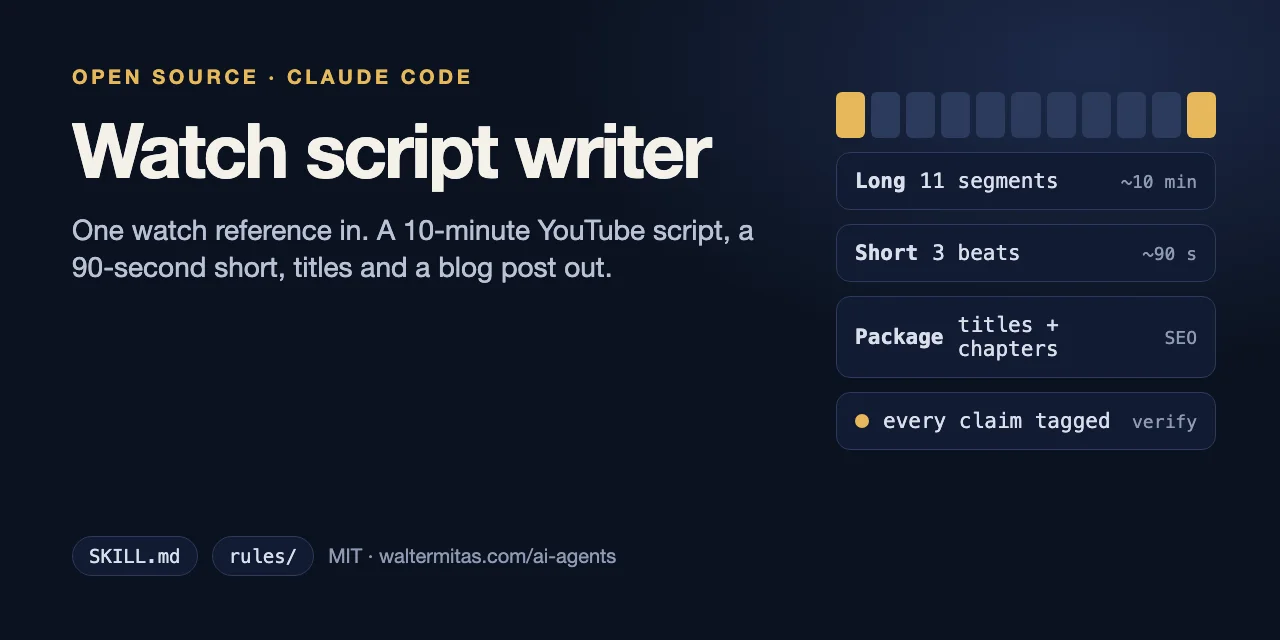
A Claude Code skill that turns a watch reference into a retention-engineered 10-minute script, a 90-second short, titles, chapters and a companion blog article, all from one round of research.

  • A retention map first: one master loop, two or three open loops closed in order, and a forward-pulling line at every transition.
  • Every claim is tagged by confidence, and anything unverified is flagged for the host to confirm before filming.
  • The rules live in separate files, so changing how every script sounds means editing one file, never the skill.
What broke

An AI agent citing its own published output back to itself looks like independent research. The sourcing rules now put realized sale prices first and label asking prices as asking.

git clone https://github.com/waltermitas/watch-script-skill.git
cp -r watch-script-skill ~/.claude/skills/watch-script

Then adapt rules/style-guide.md to your own channel’s voice.

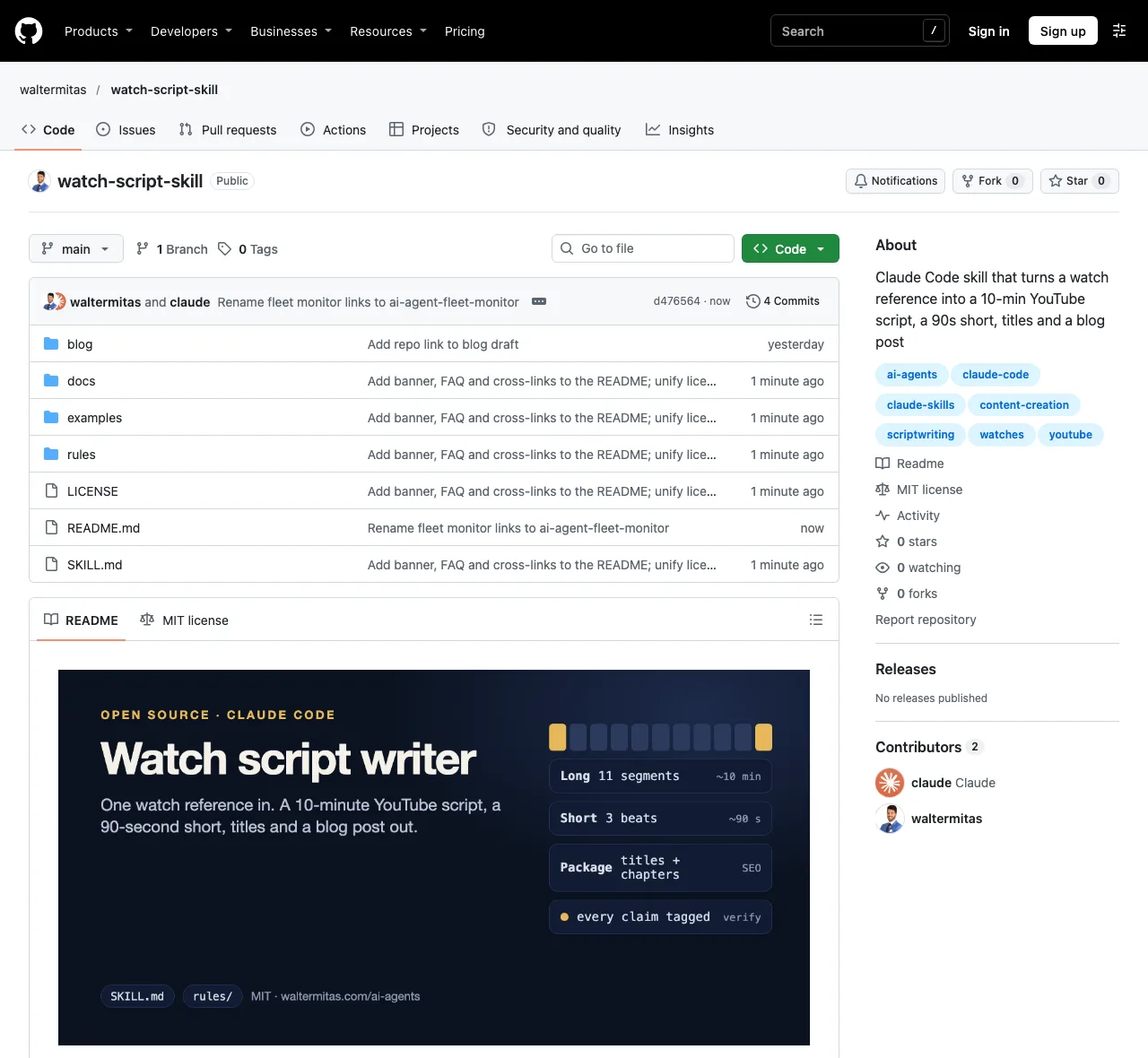
The watch-script-skill repository page on GitHub, showing the README banner and badges
The repository as published on GitHub.
How they fit together

One fleet, one safety net.

The watch hunter and the SEO autopilot are the workers. The monitor watches all of them. Each worker pings when it starts and when it finishes, the dead-man check runs every five minutes, and the control tower wakes up every few hours to read the score and send one report. The graphic below is a real day of that schedule.

One day in the AI agent fleet: scheduled runs of the watch sweep, favourites check, control tower, SEO autopilot and dead-man check
The whole fleet

Every one of them, and what it got wrong.

01

Ricardo Watch Sweep

Scans a Swiss auction site hourly for watches listed below market, and reports only the ones worth a bid.

running
02

Grail Hunter

Hunts a short list of specific dream watches across three marketplaces, and never bids.

running
03

Sell Monitor

Reads my own live listings every day, prices each against the market, and flags only the ones that are mispriced.

running
04

Personal Assistant

Captures tasks and events from a WhatsApp group, and sends back a calendar and to-do digest.

running
05

German Tutor

A daily German lesson and three grading check-ins, in character, over WhatsApp.

running
06

Training Coach

Reads measurements, progress photographs and workout logs, evaluates against the plan, and sends a check-in.

running
07

SEO Autopilot

Crawls a site weekly, fixes what it finds, and pushes the change. Monthly, it does keyword research and schedules a post.

running
08

Social Comments

Three times a day, finds relevant videos from other creators and leaves one genuinely useful comment on each platform.

running
09

Daily Spark

Reads a rotating slice of my notes each morning and sends back a few grounded ideas.

running
10

Vinted Sweep

The second-hand-marketplace twin of the auction sweep, tuned to one brand and a different currency.

running
11

Portfolio Review

A weekly pass over everything currently owned and everything being watched, re-priced against today's market.

running
12

LinkedIn Autoposter

Researches one timely topic, writes a post in two languages on a schedule, and publishes it to a company page.

running
13

Script Writer

Turns a single product reference into a researched video script, a title pack and a companion article.

running
Questions

Questions about running these AI agents

Are these AI agents free to use?

Yes. All four repositories use the MIT licence, so you can copy, change and use them commercially. You need Claude Code to run them, and the repositories themselves have no paid dependencies.

Can I use them without being a developer?

Mostly yes. The skills are plain Markdown prompts and the monitor is four small Python scripts with no dependencies. I am a technology consultant, not an engineer, and I built them by directing Claude Code. Expect to edit a config file and schedule a few tasks.

Do any of these AI agents spend money or place bids?

No. None of them can spend money, bid or buy. The watch hunter favourites a lot and reports; a person decides whether to bid. The SEO skill can push changes to a site, but only inside a written list of what it may touch.

Is it safe to let an AI agent push SEO changes to my site?

It is safe with guardrails: a build that fails on hard errors, a list of things it must never change, weekly caps, one commit per run and an easy revert. If you want review, set the deploy rule to open a pull request instead of pushing.

How do I know when a scheduled AI agent fails?

Add two ping lines to each task, one first and one last, and run the dead-man check every five minutes. A run that starts and never finishes raises an alert. The fleet monitor repository has the scripts and the exact prompt lines.

Do the repositories include the scrapers and private data?

No. They contain the method, the rules and the lessons. The scrapers, ledgers, chat details and account setups that are specific to my own businesses are not published.

WHAT BROKE

Every AI agent page ends with what it got wrong. That is the useful part: inverted signals, throttles stamped at the wrong end of a run, an AI agent citing its own published output back to itself as independent research.