Walter Ponce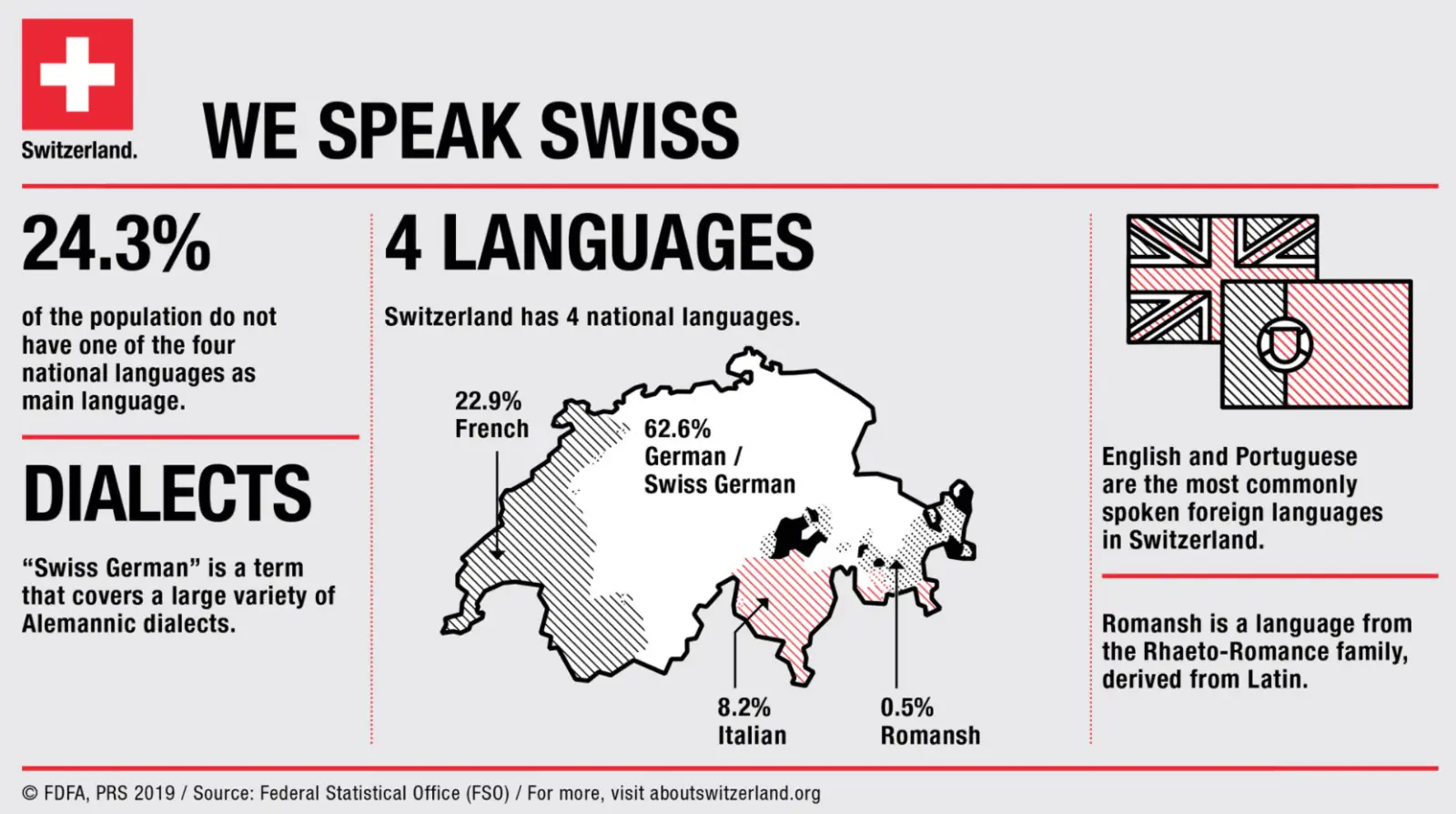
Many people asked me, which language Swiss people speaks? Does the Swiss language exist?
To this I would answer, yes and no! Switzerland** is one of the countries with the most cultural diversity that exists** and for this reason it is multilingual and there are several official languages. There really are many countries within the same country. On the other hand, when it comes to traveling to Switzerland, it is nice to know what kind of culture one is going to find upon arrival.
The languages in Switzerland
As you can see on the map the four languages spoken by region, we see that German is the predominant language without a doubt, in scale comes French, then Italian to the south and finally Romansh, which is spoken by a minority.
What should be noted is that along with the language, customs and lifestyles are ingrained. There are really **thousands of cultures within a country. **It is very common to find in a language course in Zurich students who settle in the city to learn the language and who live in French Switzerland just 40 minutes away.
The funniest thing is that you cross from a German-speaking canton to a French-speaking canton and automatically the signs on the streets, the people and the shops make a difference. In turn, official documents, banks, newspapers, absolutely everything is done in the official language of the canton.
Swiss German
One fact to note about German-speaking Switzerland is that the Swiss dialect is used for everyday communication, however Standard German (called Hochdeutsch) is the language used for written communication .
In this way, at school or university, texts and writing are developed in the base German, but when we go out on the street we hear terms and words that have no relation to the base language .
The differences do not end there. Many people have asked me, how is it that, if Swiss German is so embedded in Swiss culture, why is it still a dialect and not considered an official language?
This is because, apart from the **lack of an official grammar, each canton in turn has its own dialect. **That is, it is not the same Swiss German spoken in Zurich as the one spoken in Bern. So in order to create a language, all the cantons would have to agree and create an official grammar for the entire country. Something that is too difficult, because we know that in terms of cultural identity nobody wants to give in.
It is such a small country with so many cultural differences that it is totally normal for a person from the French part of Switzerland to settle in Zurich to learn German.
French
The language that represents almost 25% of the population and that, as you saw on the map, settles mostly in the northwestern region of the country. There are four cantons with French as the official language (Geneva, Vaud, Neuchâtel and Jura) and three others are added to these, which are the mixed cantons of Switzerland where both German and French are spoken. These are Valais, Freiburg and Bern, although in Valais French is the predominant language, this is not the case for Bern and Freiburg where German is predominant.
French Switzerland is called Suisse Romande or **Roman Switzerland / Romande. **Although the language is the same as that spoken in other French-speaking countries , there are some regional and grammatical differences, but they do not reach the extreme of the differences between Swiss German and German.
Italian
Well, the only canton that has Italian as the official language is Ticino in the south of Switzerland, for me, one of the most beautiful cantons in the country. To this is added the canton of Grisons, in which it admits the three official languages, these being German, Italian and Romansh.
Romansh
This language is only spoken by less than 1% of the population and is a mixture of the other three official languages of the country. It has Latin origin.
As you may have seen, there are many cultures within one. **Change the lifestyle, the way of thinking, the typical foods and even the way of speaking. **I admire how they can achieve good coexistence in this country while being so different. I think that living here opens your mind a lot, makes you see how you can learn a lot from people who don’t think like you, and how integration is the protagonist of the country.
The Languages in Numbers
According to the Swiss Federal Statistical Office, the approximate share of the population that names each language as a main language is:
- German (mostly Swiss German dialects): around 62%
- French: around 23%
- Italian: around 8%
- Romansh: around 0.5%
Because people can name more than one main language, and because many residents come from abroad, other languages like English, Portuguese and Albanian are also widely spoken.
The “Röstigraben”
Swiss people often joke about the Röstigraben, or “rösti ditch”, the invisible cultural line between German-speaking and French-speaking Switzerland. It is named after rösti, the grated potato dish typical of the German-speaking side. The term is used to describe differences in voting patterns, attitudes and lifestyle between the two regions. Bilingual cities like Biel/Bienne and Fribourg/Freiburg sit right on this line, and street signs there appear in both languages.
A Few Swiss German Words to Know
If you visit or move to the German-speaking part, these everyday words will help:
- Grüezi – Hello (formal). In Bern you may also hear “Grüessech”.
- Hoi / Sali – Hi (informal).
- Merci vielmal – Thank you very much. Yes, Swiss German borrows “merci” from French.
- Uf Widerluege – Goodbye.
- Äxgüsi – Excuse me.
- Znüni / Zvieri – The mid-morning and afternoon snacks.
Do You Need to Speak a Local Language?
- For tourists: English is widely understood in hotels, restaurants and train stations, especially in cities and tourist areas.
- For residents: Learning the local language makes a big difference for daily life, work and integration. Some permits and naturalisation processes require proof of language level.
- For work: Many international companies use English, but local language skills open more opportunities.
Tips for Learning German in Switzerland
- Start with Standard German (Hochdeutsch). It is the language of writing, school and most courses.
- Expose yourself to Swiss German through local radio, TV and conversations, even if you don’t speak it.
- Don’t be shy to ask people to switch to Hochdeutsch. Most Swiss are happy to do so.
- Use local resources like language schools, community courses and conversation groups.
FAQ
How many official languages does Switzerland have? Four: German, French, Italian and Romansh.
Is Swiss German an official language? No. German is official, while Swiss German is a group of spoken dialects.
Which language is most widely spoken? German, spoken by around 62% of the population as a main language.
Can I get by in English? In most cities and tourist areas, yes.
Where is Romansh spoken? In parts of the canton of Graubünden (Grisons).